We Taught
Rocks to Talk
From Markov chains (1913) to autonomous agents (2026)

 CONNECT ON LINKEDIN
What is Artificial Intelligence?
- AI covers Vision, Robotics, and more.
- Machine Learning includes NLP.
- LLMs are one small part.

Language used to be a small corner of AI, and now it's the part everybody means.
software that does a job we would call thinking.
NLP isthe part of it aimed at human language.
- Once separate fields.
- Whole careers spent on one.
- Now, prompts for one model.
A hundred and thirteen years, in twenty-three stops.
A Russian mathematician counting letters in a novel by hand, because there isn't a computer anywhere on Earth yet.
Software that reads your codebase, makes the change and runs the tests while you go get a coffee.
Almost none of this was invented from scratch. Count how often the new thing is somebody's old idea.
- You don't need every detail.
- Lost? Just hang on.
- Big year on screen? We're starting new.
Six words, and where each one turns up.
Andrey Markov works out the maths for things that depend on what came before.
Three decades before there's a machine to run it on.
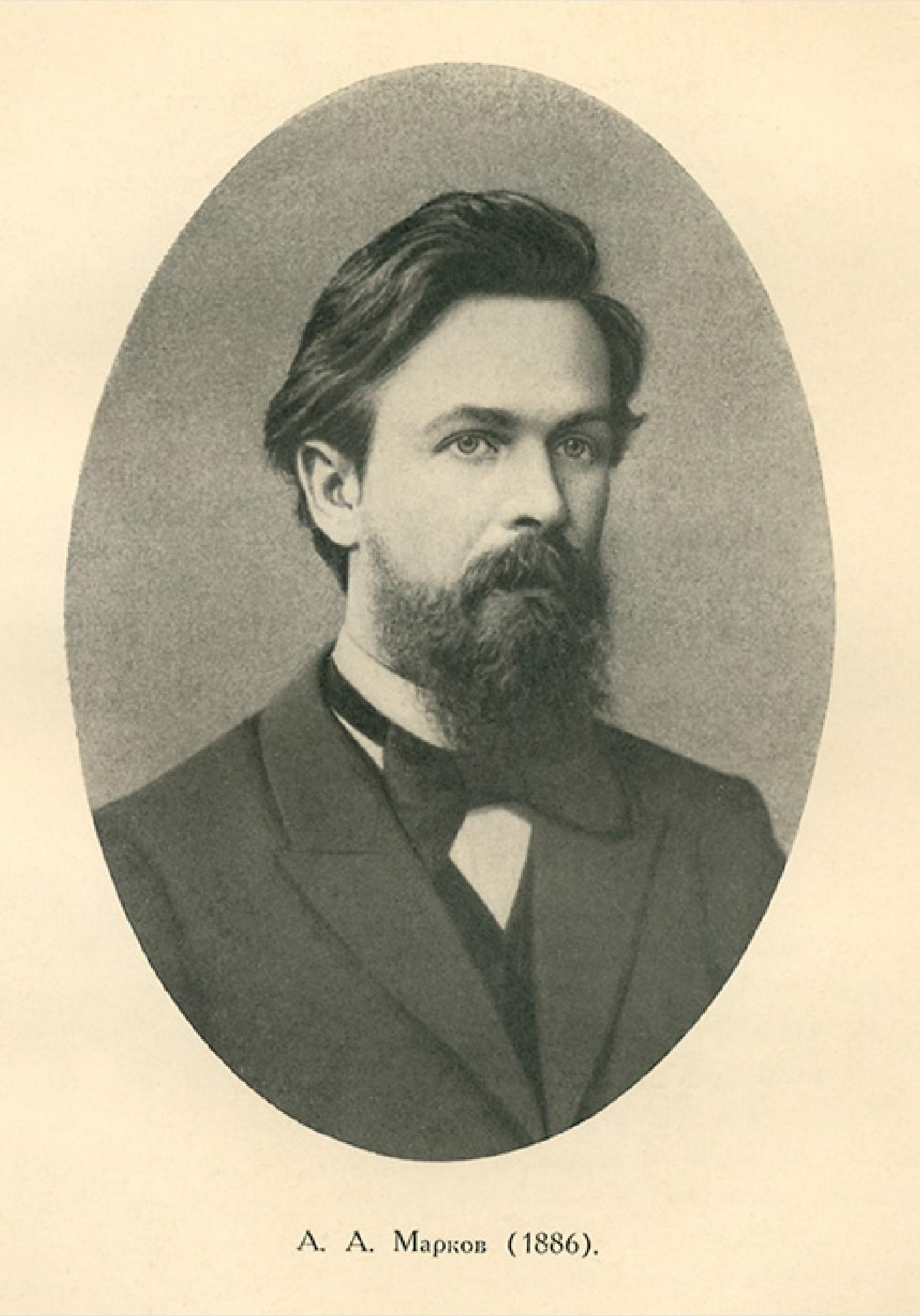
public domain
He counted 20,000 letters of a novel by hand.
- Probability assumed independent events.
- Markov proved laws survive dependence.
- He tested on 20,000 letters.
- He invented the Markov chain.
8,638 vowels · 11,362 consonants · every row sums to 1
- Dependent, yet predictable.
- Past changes future odds.
The states can be anything, not just letters.
- Simulate weather with sunny and rainy.
- Real weather clumps.
You need only the current state, never the whole history.
Every row sums to 1. That's the only rule.
- Swap weather for words.
- Same maths runs PageRank.
Claude Shannon generates English by picking likely next words.
In the paper that invents information theory.
Who’s happy with autocomplete?
N words in a row, counted.
Who just thought “mat”?
- No parsing required.
- Just seen them together.
Slide the window across billions of words of newswire, parliamentary records and eventually the web, tallying every sequence as you go. That's the training.

Keep the last n words, which is your context window, and throw the rest away.
One count divided by another, and no grammar anywhere.
- n usually stopped at five.
- Modern context windows are huge.
Alan Turing asks, in print, “Can machines think?”
Seventy-six years ago.
Who already knows what the Turing Test is?
He asked the question, then quietly changed it.
- “Can machines think?”
- Hard to define thinking.
“…too meaningless to deserve discussion.”
Turing, on his own question
- Testable substitute: tell them apart?
- Called the imitation game.
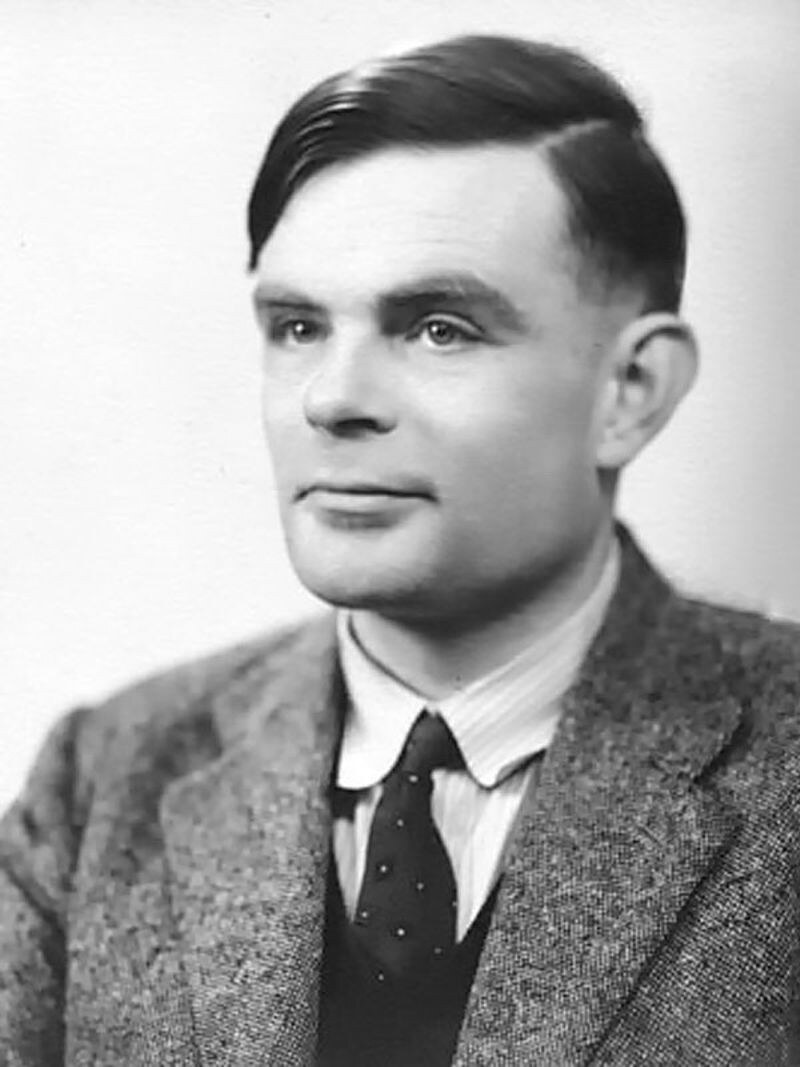
A judge, two hidden players and a screen.
- 1A judge questions two hidden players, A and B.
- 2Everything goes through a teleprinter, so typed words only.
- 3The judge says which is which.
- 4Now swap one player for a machine.
- Fool the judge 30%.
- Expected by 2000.


Zellig Harris: you can tell what a word means by the company it keeps.
Meaning, treated as a statistic.
You can spot spam without reading a word.
- Message becomes a word tally.
- Spam words mean bin.
- Answers “what document type?”
- Cost: Word order lost.
Three words, and it already looks far more like the left pile than the right. No reading required.
Declared nearly solved, then defunded.
- 1954: IBM 701 translates Russian.
- 250 words, six grammar rules.
- IBM: “an unqualified success.”
“Five, perhaps three years hence … may well be an accomplished fact.”
Leon Dostert, Georgetown, at the demonstration
- 1966: Government reviews the progress.
- Finds “no immediate prospect.”
- Funding collapses. Language research dies.
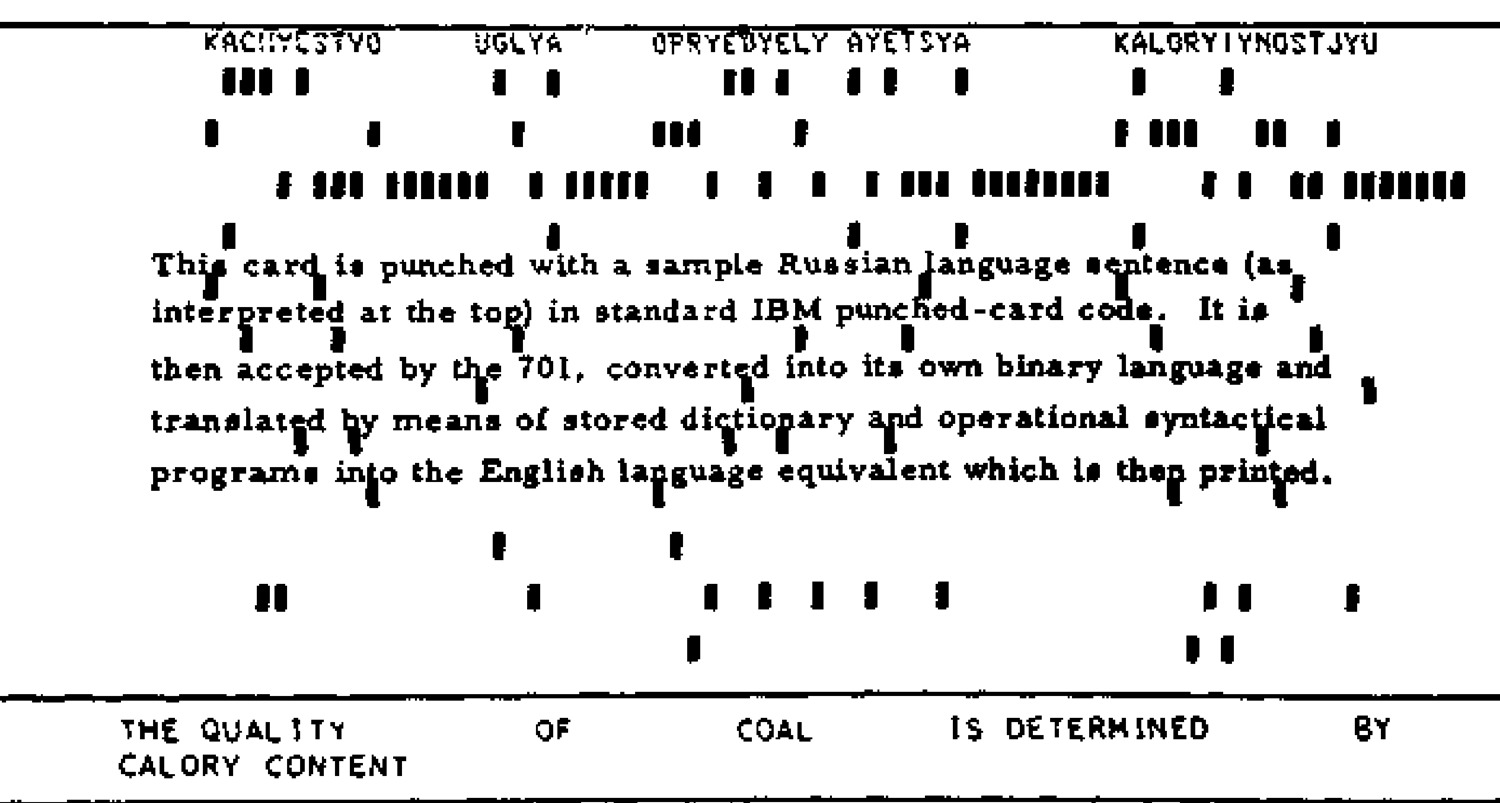
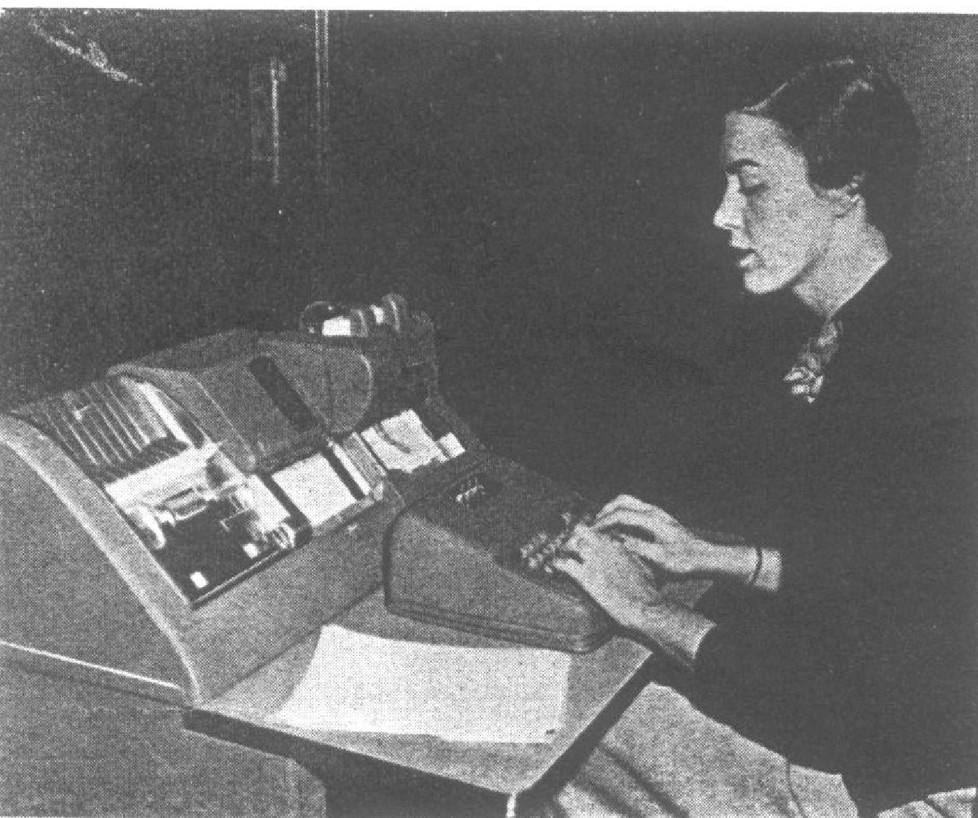
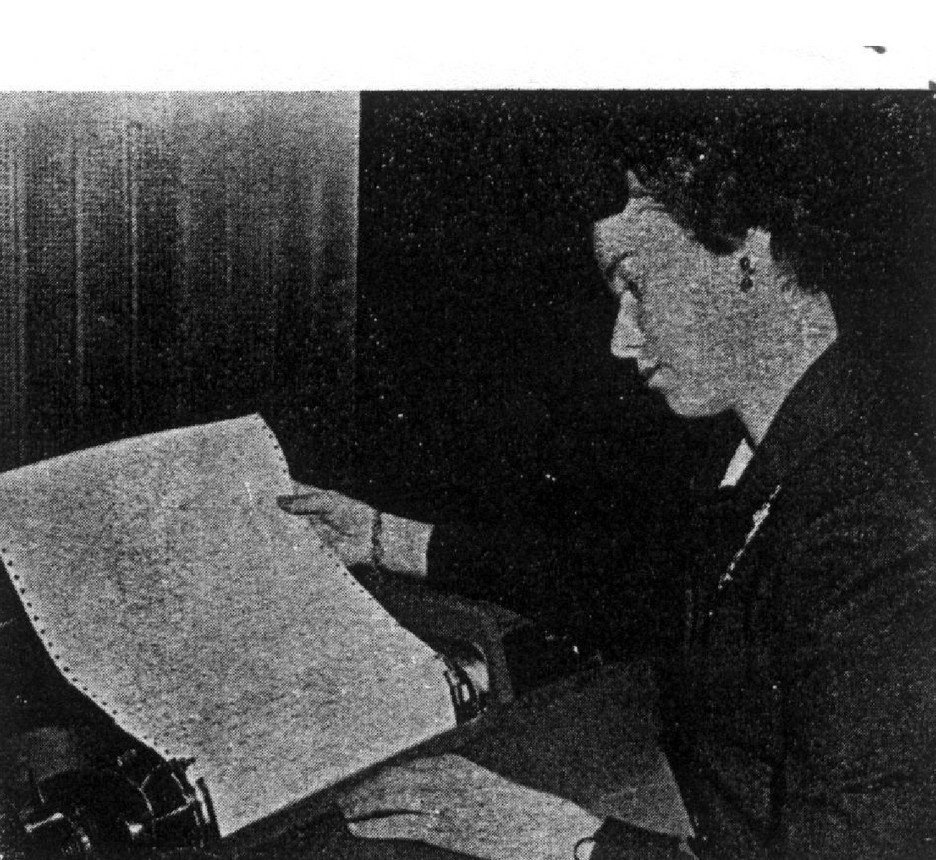
IBM press materials, 7 January 1954
Joseph Weizenbaum, at MIT, publishes ELIZA.
The first convincing chatbot.
Who thought the first chatbot was younger than you?
Keep it up if you thought it was younger than your parents.
He wrote it to show how little it took.
- Script called DOCTOR (therapist).
- Knows nothing, echoes your words.
- People confided in it anyway.
- His secretary asked him to leave.
- He later argued against it.
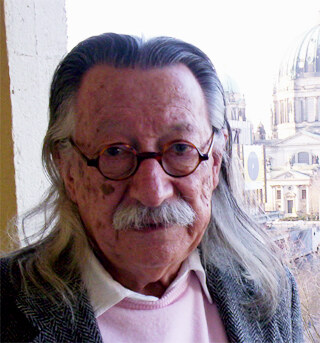
People queued to use it. It was copied onto home computers for the next twenty years, and practising psychiatrists proposed developing it into real therapy. Reading understanding into a machine that has none is still called the ELIZA effect.
Two kinds of rule, and neither one reads.
- Reflect it: Swap pronouns, echo.
- Match word: Fire stock line.
- Recognised nothing? PLEASE GO ON.

Stores your “my …” sentences. When it recognises nothing, it replays one: EARLIER YOU SAID YOUR …
Keywords carry a priority. In “everybody laughed at me”, everybody outranks me.
Several replies per rule, used in turn — so it never answers the same shape twice running.
don't → do not · you are → I am, so the sentence
comes back grammatical.
Every one of them is a lookup. Nothing consults the dashed box.
Terry Winograd builds a program that genuinely understands you.
Inside a world containing seven blocks.
Language in, actions out, all inside a sandbox.
- Plans moves, changes the world.
- That's tool use in 2026.
- Every fact typed by hand.

A machine that walks through your sentence.
- Grammar as networks of states.
- Augmented means memory and calls.
- Phrases containing phrases: recursion can.
Woods, Communications of the ACM, October 1970. POP hands control back to whoever called you — and both NP arcs call the same network.
Somebody tries to label every word in a million-word corpus — automatically.
77% automated accuracy; the remaining 23% corrected by hand.
What kind of word is this?
- Tag every word in a sentence.
- What it's doing here.
Is book a noun?
- Only the sentence can tell.
- A tagger reads the neighbours.
book → NOUN · a thing you hold
book → VERB · an instruction
Same four letters, and nothing inside the word decides which one it is.
Twenty-three years to read a word.
- 1971: Hand-written rules, 77%.
- 1987: Statistical context, 96–97%.
- Then it stops near 97%.
- The task has a ceiling.
The same numbers as errors: 1 word in 4 wrong → 1 in 29 → 1 in 36.
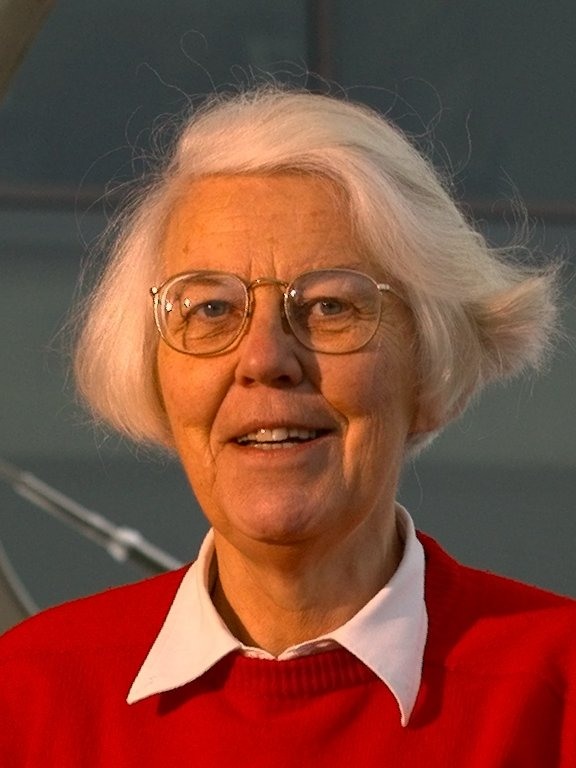
Karen Spärck Jones works out which words actually matter.
Twenty years before there's a web to search.
The commonest words tell you almost nothing.
- Common words make documents identical.
- Discount words that are everywhere.
Frequent here and rare everywhere else → informative. In every document → worth nothing.
- 1972: Decades before the web.
- Powers every modern search engine.
Speech recognition stops trying to understand anything.
Hidden Markov Models replace rule-based acoustic parsing.
Ask what's most likely, not what it means.
- Hidden words, observed noise.
- Guess the most likely sequence.
- No grammar, still beat rules.
- Why your phone dictates.
“Every time I fire a linguist, the performance of the speech recogniser goes up.”
attributed to Fred Jelinek, IBM

The counting finally has enough to count.
Large-scale digital corpora enable statistical methods.
Statistical translation scales with parallel corpora.
- IBM trains on Canadian Hansard.
- Same math, just more text.
- No grammar. Just counting words.
Putting the counting to work.
Turning 90s statistical tallies into practical outcomes: sentiment, topics, and classification.
The same counting, pointed at feelings.
- Score bags for sentiment.
- Cluster bags for topics.
- Still can't read. Sarcasm breaks it.

One number, from a pile of counts.
Yoshua Bengio stops treating words as symbols and starts treating them as numbers.
Dense vector representations for neural language modeling.
Give every word a list of numbers.
- Before: cat unrelated to kitten.
- Now: words get number rows.
- Kitten looks like cat.

Words → a learned table of numbers → a prediction.
A list of numbers is a place.
- Two numbers plot a point.
- Distance measures meaning.
- The list is a vector.
Two numbers per word, plotted: cat and kitten sit 0.6 apart, and Tuesday is 7.6 away.
A team at Google works out how to put meaning on a map.
Mikolov et al. introduce Word2Vec and vector space arithmetic.
Meaning, as a direction you can travel.
- Directions reveal meaning.
Who got queen?
- Machine gets queen too.
- Math emerges from text.

The step from man to woman is the same step as king to queen.
word2vec: read a lot of text, and give every word numbers based on the company it keeps.
It unlocksSimilar meaning becomes similar numbers, so a machine can measure meaning instead of matching letters.
Analogies as vector arithmetic.
- Subtract two, add one.
- Nobody programmed these.
- Scores only 60%.
- Right shape, wrong details.
- This is hallucination.
Table 8, “Efficient Estimation of Word Representations in Vector Space” · skip-gram, 783M words, 300 dimensions.
Almost nobody used it for analogies.
- Vectors became easy.
- People asked: what's nearest?
- This was early RAG.
Two lines of Python, and the values are illustrative.
- 1Turn every document into a vector.
- 2Turn the question into a vector.
- 3Return the documents nearest to it.
Reading word by word: the recurrent loop.
- Read one word sequentially.
- Pass memory to next word.
- Cannot run in parallel.
The RNN Recurrent Loop: folded cell (left) and unrolled sequential chain (right).
Read text one word at a time, carrying hidden memory from word to word.
It unlockedVariable-length input — neural networks could handle full sentences instead of fixed bags of words.
The memory bottleneck.
- LSTM added memory gates.
- Squeezes sentence into one vector.
- Fixed box drops details.
The seq2seq bottleneck: input length grows, vector size stays fixed.
Long Short-Term Memory (LSTM) gates allowed networks to remember words longer.
The flawFixed-Vector Bottleneck — squeezing 50 words into a 512-D vector forced early words to fade.
A translation model is allowed to look back at any word it wants.
Bahdanau et al. introduce neural attention mechanisms.
Let it look back at everything.
- Old models crushed long sentences.
- Attention looks back at everything.
- The window is gone.
“She grew up in France, moved abroad for work, lived in three different countries for twenty years, and yet at home she still speaks fluent French.”
Attention connects France (17 words back) directly to predicting French.
A score for every pair of words, saying how much one should listen to the other.
It unlocksDistance stops costing anything, so word one and word fifty are one step apart.
Every word asks a question, and the others answer.
You know it means the animal. Nothing in the model was told that. Here's what it computes instead.
- Query: What I want.
- Key: What I offer.
- Value: What I contribute.
A dot product. Two vectors pointing the same way score high. That is the entire definition of “relevant”.
- Weights add to 1.
- A budget of attention.
Illustrative weights. The new vector for it is now mostly “animal”, so the word has been rewritten to carry what it refers to.
- softmax(Q·Kᵀ) · V
- Score, normalise, average.
- For every word at once.
Everything the Transformer needed already existed.
- Added three new things.
- Threw the RNN away.
- An assembly that changed everything.
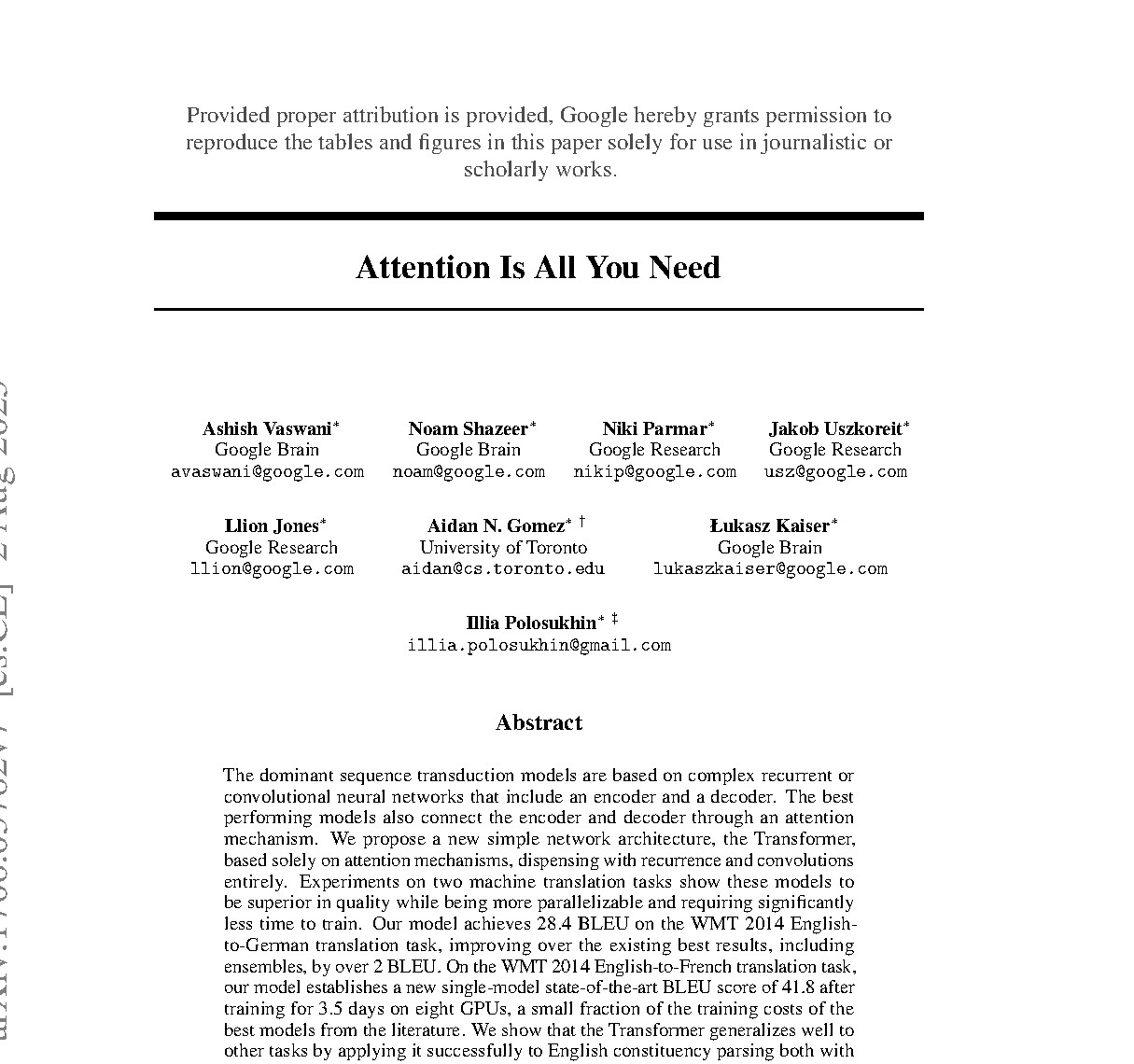
Eight people at Google publish a paper with a very confident title.
Vaswani et al. publish "Attention Is All You Need", introducing the Transformer.
“Attention Is All You Need”
- Old models read one word at a time.
- Throw all that away.
- Keep only attention.

- Process words at the same time.
- Massive parallel training unlocked.
- Everything after is this architecture.
Took the recurrence out, and kept only attention.
It unlocksNothing waits for anything, so you can train it on the whole internet.
From input text to probabilities.
- Encoder on the left.
- Decoder on the right.
- 1Positional Encoding: Adds word order numbers.
- 2Multi-Head Attention: 8 parallel attention heads.
- 3Add & Norm: Residual connections for 100+ deep stacks.
- BERT uses Encoder (understanding).
- GPT uses Decoder (generation).
Figure 1: The Transformer — model architecture (Vaswani et al., 2017).
Eight words, and seven are older than the paper.
- Look at the right column.
- Only one word is new.
- The rest were waiting.
One word doing two jobs.
- word2vec gives one vector per word.
- "Bank" becomes a blur of both.
- BERT gives occurrences vectors instead.
→ money, crime, a building
→ mud, water, the edge of a thing
This is “is book a noun or a verb” from 1971, the same four letters doing two jobs. That one was about grammar and this one is about meaning, and the answer is the same: read the neighbours.
Bigger stopped being boring.
- More data. More compute. Same architecture.
- It learned new jobs without training.
- Prompting was born here.

Same idea, four orders of magnitude.
More data and more compute buy you a predictable amount of accuracy. You can plot it.
It unlocksYou can budget for intelligence — which is why the billions started arriving.
Change the behaviour without touching the model.
- Classic fine-tuning updates every weight.
- LoRA trains small side matrices.
- Megabytes. Single-GPU. Swappable adapters.
- Make it sound like you.

Fine-tuning changes the model, and RAG only changes what you hand it.
Don't learn a new matrix. Learn two thin ones.
- Model is stacked weight matrices.
- Take one: 16.8 million numbers.
- Fine-tuning changes every single one.
Multiply a tall-thin ($4096 \times 8$) by a short-wide ($8 \times 4096$) and you get a full-size matrix — but one that can only vary in 8 directions. Adapting is a nudge, not a rebuild.
W never moves. Only A and B get gradients — 65,536 numbers instead of 16.8 million per matrix. That's the whole saving.
Fold W + B·A into one matrix and it runs at original speed. Or keep them apart and swap A and B per task/customer like plugins.
Somebody had to teach it manners.
- Predicting text isn't helping.
- RLHF teaches good answers.
- Behaviour beats size 100×.

Nothing new at the bottom, and everything new at the top.
There were never any facts in there.
- Fluent and true are separate.
- Making things up is default.
- Put facts in front.

You have already seen this slide.
- Turn documents into vectors.
- Measure documents instead of words.
- Embeddings made similar a number.
- 1Turn every document into a vector.
- 2Turn the question into a vector.
- 3Hand it the documents nearest to the question.
A great deal of production retrieval is still BM25 — keyword counting built on Spärck Jones, 1972. Fifty-year-old maths, doing the fetching, inside your 2026 AI. Most serious systems run both.
Fetch the real documents, then answer from those.
It unlocksIt can answer about your documents, with no retraining.
Let it think for longer.
- Spent more words first.
- Two dials: size and time.
- More effort on hard problems.

Two dials now, rather than one.
It writes out its working first, often for thousands of words you never see.
It unlocksYou can turn the effort up for a hard question and down for an easy one.
Language in, actions out. Sound familiar?
- Give it tools to act.
- MCP: USB-C for AI.
- This sandbox holds reality.

One plug, many sockets.
Model Context Protocol: one agreed way for a model to call any outside tool.
It unlocksWrite the tool once and every model can use it, with no integration per model.
Run the loop without asking permission each time.
- Same model in a loop.
- No human in every turn.
- What that buys is duration.

The same four steps, over and over again, unattended.
The same model, called over and over, choosing its own next step each time.
It unlocksYou stop asking a question and start handing over a task.
Sixty years, same conversation.
- Both felt like talking.
- We stopped keeping score.
- So what actually happened here?
Thank you.
We taught rocks to talk.
CONNECT ON LINKEDIN
This talk was built with the thing it's about.
Primary sources, cross-checked, and where they disagreed the slide says so instead of guessing.
Every blueprint generated to a written spec, in one house style.
Photographs licence-checked, credits logged, attribution kept where required.
Plain HTML in version control, assembled by a script and screenshot-tested one slide at a time.
- Want the prompts? Come ask. flintsparklabs.com